





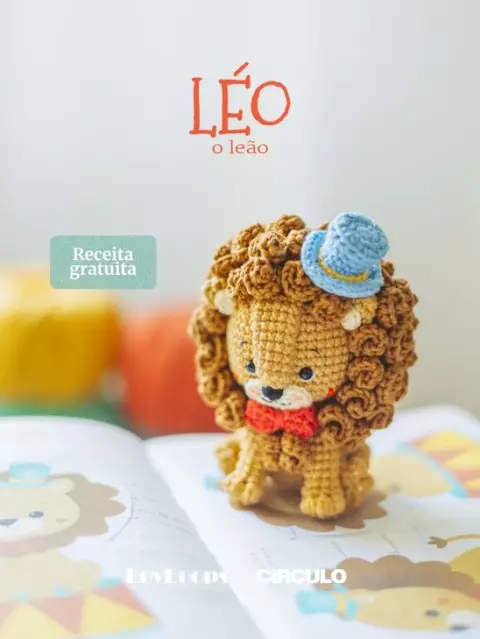
Leo, the lion
MATERIAIS
- Círculo Amigurumi yarn in colors:
- Black #8990;
- Caramel #7076;
- Hydrangea #2137;
- Cherry #3583;
- Craft #7148;
- Cream #1112;
- Magnolia #1205;
- Off-White #8176 (leftover yarn to embroider the eye waterlines).
- Embroidery thread Maxi Mouliné in colors:
- Black #900 (for eyebrows and snout);
- Cherry #226 (for cheeks);
- Peach #208 (for freckles and paw details).
- 5 mm Black round safety eyes (2 units).
- 2.0 mm Crochet hook.
- Embroidery needles (Tapestry no. 22, Crewel no. 9, and Milliner no. 5).
- Fiberfill.
- Stitch markers.
- Sewing pins.
- Scissors.
- Pliers.
- Silicone or fabric glue.
EXECUÇÃO
ABBREVIATIONS (US Terms)
- BLO: back loops only.
- 3-dc-bobble: bobble stitch made with three double crochets (three incomplete dc worked in the same stitch and closed together).
- Ch: chain stitch.
- Dc: double crochet.
- Dec: single crochet decrease (two sc closed together).
- FLO: front loops only.
- Hdc: half double crochet.
- Hdc-inc: half double crochet increase (two hdc into the same stitch).
- Inc: single crochet increase (two sc into the same stitch).
- Rnd: round(s).
- Sc: single crochet.
- Slst: slip stitch.
- St: stitch(es).
- [...] x n: repeat the instructions, within brackets, n times.
- (...): total number of stitches in a round.
SIZE
- Using Círculo Amigurumi yarn, 2.0 mm crochet hook, and X single crochet, your lion Leo will be approx. 4.72 in (12 cm) tall, including the top hat.
SKILL LEVEL
- Advanced.
Crocheting Instructions
SNOUT
In color Cream (#1112).
Ch 5. Stitches are worked around both sides of the foundation chain.
Rnd. 1: start in the second ch from the hook, 3 sc, 3 sc into the last st. Continue on the other side of the foundation chain, 2 sc, 1 inc (10).
Rnd. 2: 1 inc, 2 sc, 3 inc, 2 sc, 2 inc (16).
Rnd. 3: work only 1 sc, 1 slst (2). Leave the remaining 14 st unworked.
Invisible fasten off, leaving a long tail for sewing.
NOSE
Start in color Black (#8990).
Rnd. 1: work 5 sc in a magic ring (5).
Change to color Caramel (#7076).
Rnd. 2: 5 BLO-slst (5).
Note: To make the next round easier, work the slst loosely. If your stitches are naturally tight, consider using a larger hook for Rnd. 2.
Rnd. 3: 4 inc, 1 sc (9).
Rnd. 4: 9 sc (9).
Rnd. 5: 8 sc, 1 inc (10).
Rnd. 6–7 (2 ROUNDS): 10 sc (10).
Rnd. 8: 9 sc, 1 inc (11).
Rnd. 9–11 (3 ROUNDS): 11 sc (11).
With the increase from Rnd. 8 centered, flatten the nose opening so that the stitches line up. If needed, work additional sc until you reach the side of the piece. For my piece, 3 additional sc were required.
Add a small amount (just a tiny bit) of stuffing to the nose, up to Rnd 4. Then we'll close the opening.
Rnd. 12: sc in next 5 st through both layers to close the opening.
Fasten off, leaving a long tail for sewing.
HEAD
In color Caramel (#7076).
Rnd. 1: work 6 sc in a magic ring (6).
Rnd. 2: 6 inc (12).
Rnd. 3: [1 sc, 1 inc] x 6 (18).
Rnd. 4: [1 sc, 1 inc, 1 sc] x 6 (24).
Rnd. 5: [3 sc, 1 inc] x 6 (30).
Rnd. 6: [2 sc, 1 inc, 2 sc] x 6 (36).
Rnd. 7: 36 sc (36).
Rnd. 8: [5 sc, 1 inc] x 6 (42).
Rnd. 9–16 (8 ROUNDS): 42 sc (42).
Insert the safety eyes between Rnd. 13 and 14, centered on the opposite side of the starting point of the rounds, leaving 4 visible st between them.
Note: The ideal eye size should be slightly smaller than 2 stitches in height and 2 stitches in width. If necessary, adjust the eye size to fit your piece.
Rnd. 17: [5 sc, 1 dec] x 6 (36).
Rnd. 18: [2 sc, 1 dec, 2 sc] x 6 (30).
Rnd. 19: [3 sc, 1 dec] x 6 (24).
Stuff the head with fiberfill.
Rnd. 20: [1 sc, 1 dec, 1 sc] x 6 (18).
Rnd. 21: [1 sc, 1 dec] x 6 (12).
Rnd. 22: 6 dec (6).
Add more stuffing if needed. Fasten off, leaving a yarn tail. Using a tapestry needle, weave the yarn tail through the front loop of each remaining stitch and pull tight to close. Weave in the yarn end.
Embroider the snout details
Embroidering the snout before the sewing step can make the process easier. However, it is important to carefully define the placement before starting.
To do this, position the snout on the face and simulate the placement of the nose in the correct spot (see instructions “Sew the snout onto the head” and “Sew the nose onto the face”). This will help you more accurately visualize where the mouth and freckles should be placed.
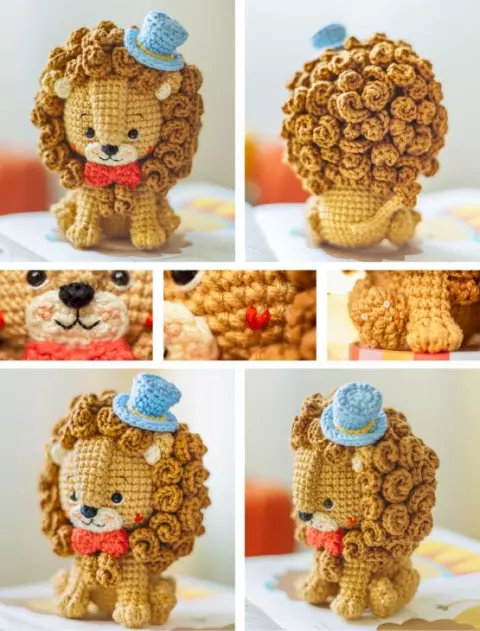
Only after testing and confirming the ideal positions should you embroider the mouth and freckles. Use the cover photo as a reference.
- Mouth: using a crewel needle and 1 strand of black embroidery floss (Maxi Mouliné #900), embroider the mouth at the center of the snout, over Rnd. 1 and 2 of the upper half of the snout.
- Snout freckles: using a milliner needle and 3 strands of peach embroidery floss (Maxi Mouliné #208), embroider the freckles by making three French knots, with two wraps each, over Rnd. 2 on each side of the snout, keeping approx. 1 mm of distance between them.
Sew the snout onto the head
Using sewing pins, center the snout on the head, just below the eyes, between Rnd. 15 and 18. With a tapestry needle, sew it firmly in place.
Sew the nose onto the face
Using sewing pins, center the nose between the eyes, positioning the straight upper edge between Rnds. 4 and 5, and the black tip over Rnd. 2 of the snout. Use the cover photo as a reference for placement. With a tapestry needle, sew firmly all around the Caramel section (top edge and sides).
Note: There is no need to sew the black tip to the snout. Once the sides of the nose are sewn, it will stay firmly in place and fit neatly on the piece.
Make the face details
- Waterline: using a tapestry needle and Off-White yarn (Amigurumi #8176), embroider the waterline at the bottom of each safety eye.
- Eyebrows: using a crewel needle and 1 strand of black embroidery thread (Maxi Mouliné #900), embroider the eyebrows over Rnd. 11. Each eyebrow should be approx. 1 st wide and 1 round high, placed approx. 1 st away from the nose.
- Cheeks: using a crewel needle and 1 strand of cherry embroidery thread (Maxi Mouliné #226), embroider heart-shaped cheeks over Rnd. 16. Each cheek should be approx. 1 st wide and 1 round high, placed approx. 2 sts away from the snout. Use the cover photo as a reference.
Note: As the placement of the cheeks depends on the position of the snout, embroider them only after sewing the snout onto the head.
EARS (MAKE 2)
In color Caramel (#7076).
Rnd. 1: work 6 sc in a magic ring (6).
Rnd. 2: [1 sc, 1 inc] x 3 (9).
Rnd. 3–4 (2 ROUNDS): 9 sc (9).
Invisible fasten off, leaving a long tail for sewing. The ears don’t need to be stuffed.
Sew the ears to the top of the head
Before sewing the ears to the head, flatten the piece. Using sewing pins, position the ears on the top of the head, between Rnd. 6 and 9, leaving approx. 6 visible st from the nose, counted along the Rnd. 9. With a tapestry needle, sew firmly in place.
INNER EARS (MAKE 2)
In color Cream (#1112).
Rnd. 1: make 2 sc, 1 hdc, 2 sc in a magic ring (5).
Tighten the magic ring as usual, but do not close the circle with an invisible fasten off. We will use the piece in the shape of a semicircle. Fasten off and weave in the yarn ends.
Glue the inner ears to the center of the ears
Using silicone or fabric glue, attach the inner ears to the front of the ears, keeping the straight edges close to the head.
LEFT FRONT LEG
Note: In this pattern, left and right refer to your perspective when looking at Leo from the front.
In color Caramel (#7076).
Rnd. 1: work 5 sc in a magic ring (5).
Rnd. 2: 5 inc (10).
Rnd. 3: 2 sc, 3-dc-bobble in each of next 3 st, 5 sc (10).
Rnd. 4: 10 sc (10).
Rnd. 5: 1 dec, 3 sc, 1 dec, 3 sc (8).
Rnd. 6: 1 inc, 3 sc, 1 inc, 3 sc (10).
Rnd. 7–8 (2 ROUNDS): 10 sc (10).
Rnd. 9: 6 sc, 1 inc, 3 sc (11).
Rnd. 10: 11 sc (11).
Rnd. 11: work only 2 sc (2). Leave the remaining 9 st unworked.
Note: The number of stitches in Rnd. 11 will depend on your stitch slant. Work as many stitches as needed so that the round ends at the side of the leg, with the bobble stitches facing forward.
Fasten off. Lightly stuff the left front leg with fiberfill up to Rnd. 7.
RIGHT FRONT LEG
Note: In this pattern, left and right refer to your perspective when looking at Leo from the front.
In color Caramel (#7076).
Rnd. 1–8: repeat Rnd. 1–8 of the left front leg.
Rnd. 9: 2 sc, 1 inc, 7 sc (11).
Rnd. 10: 11 sc (11).
Rnd. 11: work only 2 sc (2). Leave the remaining 9 st unworked.
Note: The number of stitches in Rnd. 11 will depend on your stitch slant. Work as many stitches as needed so that the round ends at the side of the leg, with the bobble stitches facing forward.
Fasten off. Lightly stuff the right front leg with fiberfill up to Rnd. 7.
BODY
In color Caramel (#7076).
Rnd. 1: work 7 sc in a magic ring (7).
Rnd. 2: 7 inc (14).
Rnd. 3: [1 sc, 1 inc] x 7 (21).
Rnd. 4: [1 sc, 1 inc, 1 sc] x 7 (28).
Rnd. 5: [3 sc, 1 inc] x 7 (35).
Rnd. 6–9 (4 ROUNDS): 35 sc (35).
Rnd. 10: [5 sc, 1 dec] x 5 (30).
Rnd. 11–12 (2 ROUNDS): 30 sc (30).
On the next round, we'll join the front legs to the body. The last st of each leg will be the starting position for the join. Make sure that the bobble stitches in Rnd. 3 of the front legs are facing you. If necessary, make some additional sc or undo some sc to ensure the correct position of the legs.
Rnd. 13: 10 sc in the body, sc into next 4 st through the right front leg and body at the same time, continue with 2 sc in the body, sc in next 4 st through the left front leg and body at the same time, 10 sc in the body (30).
Rnd. 14: in the body, make 2 sc, 1 dec, 4 sc, 1 dec. Continue making 7 sc into the first front leg (into the unworked stitches of the previous round), 1 dec in the body, 7 sc into the second front leg (into the unworked stitches). Return to the body and make 1 dec, 4 sc, 1 dec, 2 sc (31).
Rnd. 15: [1 dec, 2 sc] x 2, 2 sc, 1 dec, 7 sc, 1 dec, 2 sc, [2 sc, 1 dec] x 2 (25).
Rnd. 16: 25 sc (25).
Rnd. 17: work only 4 sc, 1 slst (5). Leave the remaining 20 st unworked.
Invisible fasten off, leaving a long yarn tail for sewing. Stuff the body firmly with fiberfill.
Note: As you stuff the piece, adjust the position of the front legs so they remain parallel and facing forward. When placing the piece on a flat surface, both front legs and body should touch the surface to ensure balance.
Sew the body to the head
With the help of pins, position the body at the base of the head, keeping the front legs facing forward and tilting the head slightly upward. At the front, the body should be positioned between Rnd. 21 and 22, and at the back between Rnd. 19 and 20. Using a tapestry needle, sew it firmly in place. If necessary, stuff the body with more fiberfill before closing the seam.
BACK LEGS (MAKE 2)
In color Caramel (#7076).
Ch 4. Stitches are worked around both sides of the foundation chain.
Rnd. 1: start in the second ch from the hook, 1 inc, 1 sc, 3 sc into the last st. Continue on the other side of the foundation chain, 2 sc (8).
Rnd. 2: 2 inc, 1 sc, 3 inc, 1 sc, 1 inc (14).
Rnd. 3: 5 sc, [3-dc-bobble in next st, 1 sc] x 3, 3 sc (14).
Rnd. 4: 5 sc, 3 dec, 3 sc (11).
Rnd. 5: 4 sc, 1 dec, 1 sc, 1 dec, 2 sc (9).
Rnd. 6: 4 sc, 3 inc, 2 sc (12).
Rnd. 7: 5 sc, 1 inc, 2 sc, 1 inc, 3 sc (14).
Stuff the paw firmly with fiberfill up to Rnd. 6. To keep the paw nicely shaped, make sure to maintain its elliptical form while stuffing. The rest of the piece will remain unstuffed.
Rnd. 8–9 (2 ROUNDS): 14 sc (14).
Rnd. 10: 7 dec (7).
Fasten off, leaving a long yarn tail for sewing. There is no need to add stuffing to the thigh.
Locate the central increase of Rnd. 6 and, from this point, flatten the thigh, shaping it into a shell-like form. This shape will ensure that the leg fits perfectly on the side of the body when sewing. With the thigh flattened and using a tapestry needle, weave the yarn tail through the front loop of each remaining stitch and pull tight to close the opening. Then, weave the remaining yarn through the leg, bringing it out at the side of the thigh, between Rnd. 7 and 8, where it will later be used for sewing.
Embroider the paw details
Using a milliner needle and 6 strands of peach embroidery thread (Maxi Mouliné #208), embroider the paw details by making three French knots, with two wraps each, between Rnd. 2 and 3 of each leg, centered on the lower part of the bobble stitch. When the lion is sitting, the three French knots should be positioned on the upper half of the paw.
Note: Take care when making the French knots, ensuring they are well anchored to the stitches. Otherwise, if worked in the gaps between stitches, they may be pulled into the fabric.
Sew the back legs to the sides of the body
Using sewing pins, place the back legs on both sides of the body, between Rnd. 5 and 9, keeping approx. 12 st between them, counted along the back of Rnd. 8. The paws should be facing forward, and the bobble stitches facing upward, positioned slightly behind the front legs. The back paws should “slightly hug” the front paws, ensuring they remain in the correct position. Using a tapestry needle, sew only the rounded part of the thigh firmly in place.
Note: Before sewing, check that the piece sits properly, with all four legs and body touching the surface. Adjust the position of the back legs, if necessary, to ensure balance.
TAIL
In color Caramel (#7076).
Ch 11. Work all the stitches in the back bumps of the foundation chain. Starting in the second ch from the hook, make 10 slst (10). Fasten off, leaving a tail for sewing.
Pull up a loop of Craft (#7148) in the space between the turning chain and the first slst made. In this position, ch 4, then make 1 slst into the initial loop. Repeat this process two more times and fasten off. Using a tapestry needle, pass the remaining yarn through the same space where the initial loop was pulled up, bringing it to the wrong side of the piece. Weave in the yarn end.
Sew the tail to the back
Using sewing pins, position the tail at the center back of the body, between Rnd. 5 and 6. Shape the tail so it curves slightly and can be seen from the front of the piece. With a tapestry needle, sew it firmly in place.
MANE
In color Craft (#7148).
The mane is worked in separate strands, which makes both the process and the sewing stage easier. As the size and number of strands may vary depending on your piece, it is important that all previous assembly and finishing steps are fully completed before starting this stage.
Work by making and sewing the strands gradually, as needed. This allows you to measure directly on the piece and adjust the length of each strand, avoiding making excess pieces or strands with incorrect sizing.
The mane requires calm and patience, as each strand will be crocheted and sewn individually. Even so, the finished look is worth it!
Base strand (head outline)
Ch 10. Starting in the second ch from the hook, make 9 hdc-inc. Without fastening off, repeat this sequence until the strand is long enough to go around the entire head of the lion, passing behind the ears and staying close to the top of the nose.
For my piece, I repeated the sequence 17 times, resulting in 17 curls.
At the end, fasten off, leaving a long tail for sewing. If needed, roll each loop to create a curled effect.
Additional strands
After securing the base strand, work the remaining strands individually, varying the number of curls according to the needs of your piece.
To fully cover the back of the head in my piece, I used, in addition to the base strand, 5 more strands with different numbers of curls: 16, 15, 13, 11, and 9. Don’t rely strictly on the number and size of strands indicated. Depending on your piece, you may need more or fewer strands, or strands that are longer or shorter than suggested.
The ideal approach is to measure, make, and sew each strand individually, starting from one side of the neck to the other, forming arcs around the head in layered rows (like a “rainbow”), until the entire surface is filled.
While sewing, maintain an approximate spacing of 5–6 mm between strands, distributing them evenly and without leaving visible gaps.
If you prefer a reduced version of the mane, you can make only the base strand, which goes around the head, and a second strand to partially fill the back. The finished look will not be the same as the full mane, but it is a quicker alternative to make.
TOP HAT
In color Hydrangea (#2137).
Rnd. 1: work 6 sc in a magic ring (6).
Rnd. 2: 6 inc (12).
Rnd. 3: [1 sc, 1 inc] x 6 (18).
For a better finish, make 1 slst to close the round. Then, make ch 1 to raise the starting position of the next round.
Rnd. 4: working from the next base st, make 18 BLO-sc (18).
Note: The first st of Rnd. 4 should be made into the base st next to the slst used to close the previous round; the last st of Rnd. 4 will be worked into the slst.
Rnd. 5: [1 dec, 4 sc] x 3 (15).
Rnd. 6–7 (2 ROUNDS): 15 sc (15).
For a better finish, make 1 slst to close the round. Then, make ch 2 to raise the starting position of the next round.
Rnd. 8: from the next base st, working in FLO, make [3 hdc-inc, 1 hdc] x 3, 3 hdc-inc (27).
Note: The first st of Rnd. 8 should be made into the base st next to the slst used to close the previous round; the last st of Rnd. 8 will be worked into the slst.
Rnd. 9: 27 slst (27).
Invisible fasten off and weave in the yarn end.
Top hat detail
To create the hat detail, pull up a loop of Magnolia (#1205) between the first and second stitch of Rnd. 7 and 8, inserting the hook from the right to the wrong side of the piece. Reintroduce the hook between the next two stitches and make 1 slst. Repeat this process, making surface slst between the stitches until you complete the round. At the end, invisible fasten off and weave in the yarn end.
Attach the top hat on top of the head
Using sewing pins, position the top hat on top of the head, over the mane and close to one of the ears. Secure it in place with silicone or fabric glue. Use the cover photo as a reference for placement.
BOW TIE
In color Cherry (#3583).
Ch 16. Ensure the chain isn't twisted, then insert the hook into the first ch. Join the foundation chain with 1 slst to form a ring. Continue working in a spiral.
Rnd. 1–2 (2 ROUNDS): [2 sc, 2 hdc, 2 sc, 2 slst] x 2 (16).
Fasten off, leaving approx. 4.72 in (12 cm) of yarn tail for finishing.
Assembly
To shape the bow, use one of the remaining yarn tails to wrap three tight turns around the center of the bow. Then, tie a knot on the wrong side of the bow, fasten off, and weave in the yarn end. To ensure better fixation of the knot, apply a small drop of glue to the wrong side of the bow.
Glue the bow tie to the center of the neck
Using sewing pins, position the bow tie at the center of the neck, over the mane, just below the snout. Secure it in place with silicone or fabric glue. Use the cover photo as a reference for placement.
YOUR LION LEO IS READY!
Designer: Jenifer - Lovloops
PRODUTOS USADOS NESTA RECEITA
RECEITAS QUE VOCÊ TAMBÉM VAI GOSTAR